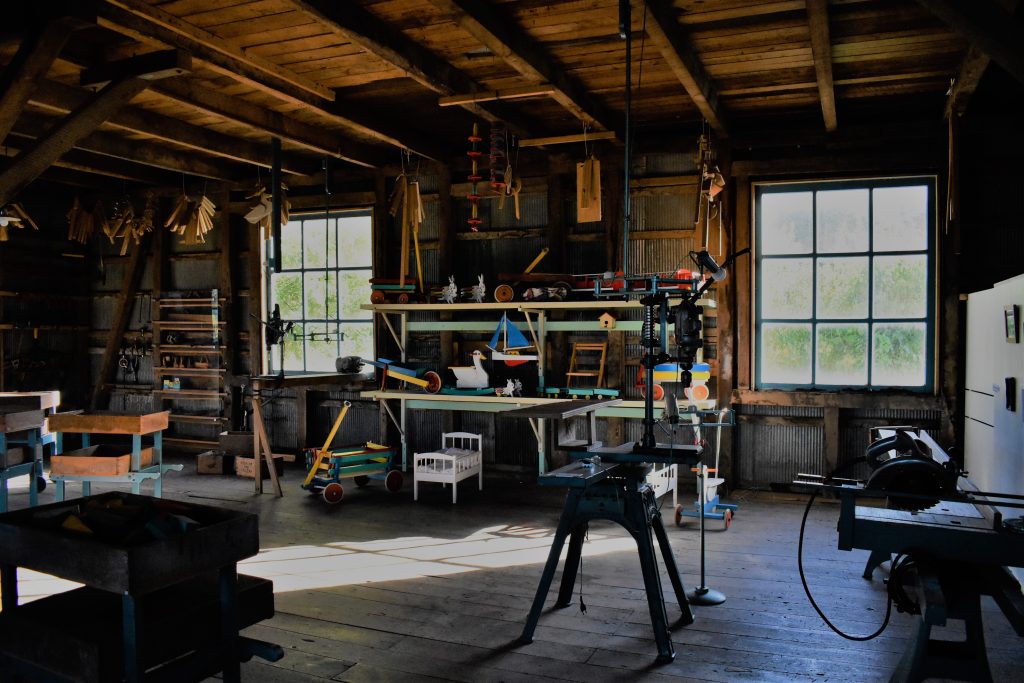
The first time I visited the Brintrup Hertling workshop in Puerto Varas, a few years ago, it felt a little like stepping back into vintage analogue. I was immediately enchanted.
When a tiny lady padded down the creaky stairs into the workshop and asked me to sign the visitors’ book, I happily obliged. “Si tienes preguntas, me avisas”—if you have any questions, let me know. Well, I didn’t hesitate.
And happily, what followed was a charming slice of local history handed straight into my lap by an actual person. Word of mouth. Something that doesn’t happen too often anymore. A real-life story, told in real life. Nothing virtual about it. And I rather loved that.
Magali Brintrup Hertling proceeded to share generous snippets of her life with me. Her childhood in 1950s southern Chile, growing up above a bustling toy workshop with her sister and their parents, Giaconda Hertling and Alejandro Brintrup.
All around us were the remnants of the world they had created: dolls’ cots and tree swings, pull-along ducks and rocking horses, fire trucks, sailing boats and wonderfully simple wooden toys, all made entirely by hand.

Magali explained that in those days, luxuries and high-end goods—least of all well-made toys—weren’t easy to come by this far south on the map. As a result, the workshop had a reputation and local children were fascinated by it. At Christmas, rather than sending their wishes to the North Pole, they would write them on cards and bring them to the workshop instead.
Alejandro and Giaconda made it their mission to ensure that every child received a toy at Christmas. Quite a feat, but one at which, Magali told me, they never failed.
Their motto became: “Para cada niño, un juguete”—for every child, a toy.
The toys were robust, colourful and beautifully crafted. They lasted through generations, from big brother all the way down to baby sister, and as Magali talked I found myself wondering where all those toys were now.
Many must still be scattered around the region—pushed to the back of an attic, perhaps, or rediscovered in the toy boxes of grandchildren. Objects made for one small pair of hands finding their way into another.

There is something almost impossibly nostalgic about it today. Not simply because the toys were handmade, but because they belonged to a time when things took time. When people waited. When materials were worked by hand and imagination filled the spaces that technology now so readily occupies.
That meeting took place in the middle of the pandemic. Both of us were wearing masks, careful not to touch anything. Careful not to cough and cause alarm. And while that marked a particular moment in time for me, time, of course, waits for no one.
Sadly, the workshop has since been dismantled, the building making way for offices and a different future. Looking at my photographs now, knowing what has disappeared, they have become something I never intended them to be: a record.
Magali had the air of someone who had told these stories many times before. Perhaps she had. But I remember feeling extraordinarily fortunate that my own path through Patagonia had brought me there in time to hear them from her.
Places disappear quietly. A workshop is emptied, tools are moved, rooms acquire new purposes. Eventually, there may be little left to suggest what happened there at all.
I’m glad I was there near the end, and that I can record a small part of their story here.