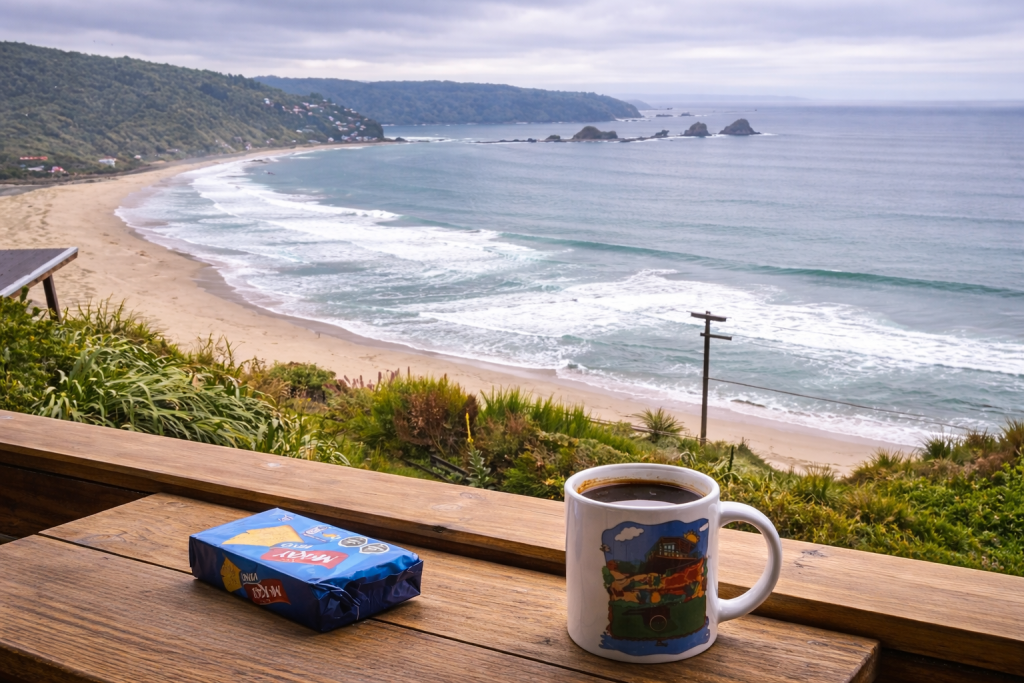
Pucatrihue, Pacific Coast — Southern Chile
Pucatrihue sits on Chile’s southern Pacific coast, where the Valdivian rainforest slopes down towards wide, untamed beaches.
It feels different from the great lakes further inland. Here, white sand replaces the volcanic, pebbled shorelines, and the Pacific is loud, restless and never quite the same twice.
Small Patagonian dolphins appear offshore, sometimes leaping through the surf. Locals say they are most active just before rain.
And, of course, it rains.
The weather is typical of a southern Chilean summer — warm rain, shifting skies and long stretches of cloud. The waves grow enormous when the weather turns, breaking against the rocks while the horizon seems to disappear into the water.
Following the coastline from Pucatrihue towards Maicolpué, Tril-Tril and Caleta El Manzano, the sense of remoteness deepens. These beaches lie within ancestral Indigenous territory, their names carrying the memory of a much older relationship with the land.
Surfers dot the breaks and small surf schools have appeared along the coast, but the area still feels wonderfully removed from the rhythms of the city. There are no large supermarkets, pharmacies or petrol stations around every corner, so it’s worth planning ahead before you visit. I spent more time than usual keeping an eye on the petrol gauge — just in case.
And yet Pucatrihue is only a few hours from Puerto Varas and Puerto Montt, with Osorno roughly sixty kilometres away.
Perhaps that is what makes this stretch of coastline so striking: it feels much farther away than it is.
A windswept edge of southern Chile where rainforest meets the sea.
Here, the continent simply ends — and the Pacific begins.
Stay: Casita Cielo · Pucatrihue, Southern Chile.